
Researchers test “smart-pill” to explore tiger stomach microbiomes
New research takes a major step toward understanding the little-known world of stomach-dwelling bacteria by feeding high-tech capsules to tigers.

An important match
While scientists know a great deal about the microbes that live in the lower intestine, far less is understood about the bacteria inhabiting the stomach. The hostile, acidic environment of the human stomach is home to just a few specialised species, including Helicobacter, a genus with a 300,000-year shared history with humans. Helicobacter is known for both causing ulcers and stomach cancer, while it also offers protection against asthma and allergies.
“The outcome of an infection depends in part on the match between host and microbe — if you’re European, it’s best to have a European Helicobacter. That’s why it’s important to be able to determine which Helicobacter strain you carry as it may be key to predicting health outcomes” says Associate Professor Sandra Breum Andersen.
A non-invasive “smart pill”
By investigating stomach microbiomes across different animal species, with a focus on Helicobacter postdoctoral researcher Dinah Maran Parker, together with Associate Professor Sandra Breum Andersen both from Center for Evolutionary Hologenomics, Globe Institute are aiming at closing the knowledge gap. The project is generously funded by Novo Nordisk Foundation.
To collect non-invasive stomach samples, the team partnered with DTU’s IDUN Center, where researchers have developed a “smart-pill” capable of sampling stomach fluid. The capsule is swallowed, automatically seals after collecting liquid, and is later retrieved from faecal material. The recovered sample allows the scientists to measure stomach pH and identify which bacteria are present, important for studying conditions such as stomach cancer.
The first test subjects: tigers at Copenhagen Zoo.
Big cats such as tigers host a Helicobacter species believed to be the closest relative to the human strain, possibly originating from an ancient encounter between a large cat and a human hundreds of thousands years ago. At the Copenhagen Zoo the Director, vets and animal care takers are eager to contribute to research, and the tigers that are trained to be hand-fed to ease health check ups were willing participants.
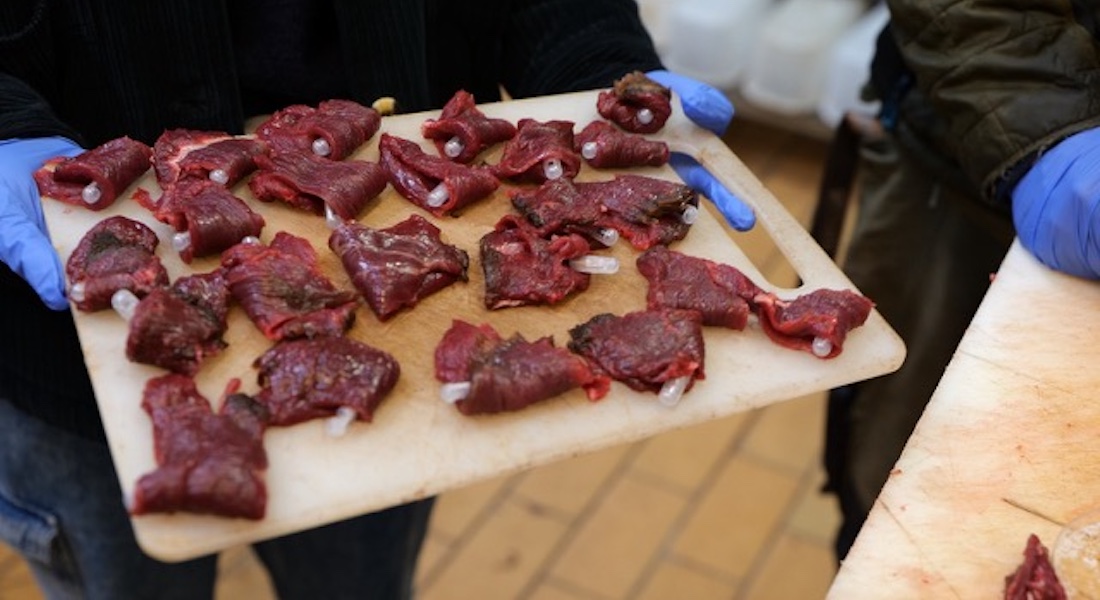
“The capsules were hidden in thin slices of raw horse meat, “a sort of horse sashimi,” and eagerly accepted by the animal.” Postdoctoral researcher Dinah Maran Parker explains.
Successful recovery
Several capsules were successfully recovered containing 100–180 microliters of clear, highly acidic liquid, most likely stomach juice. DNA extraction and sequencing are now underway. Some capsule designs showed signs of contamination during their passage through the digestive tract, giving the DTU engineers valuable data as they refine the next version.
Documentary filmmaker Andreas Johnsen joined the team at the Zoo to capture the process. Although the final use of the footage is still undecided, the researchers say the material will help illustrate their work in future presentations.
“Our measurements of gastric pH are to our knowledge the first for any big cat, and I can’t wait to see what we get from the DNA sequencing. We’re planning to sample other species at the Zoo, and the DTU team is further optimising the capsules based on the first trials” Sandra ends.
Contact:
Associate Professor Sandra Breum Andersen
Postdoctoral researcher Dinah Maran Parker